

ATS & CV Optimization
The ATS Optimization Guide for UAE & India Job Portals (2026)
Most ATS guides are written for Western job boards like Workday and Greenhouse. This one is built for Bayt, Naukri, GulfTalent, and the portals where you actually apply, because they work very differently.
ATS systems on UAE and India portals parse your CV differently from US tools, and most candidates are getting silently filtered out before a human ever sees their application. This guide explains exactly how each major regional portal scores your CV, what keywords actually matter, and what formatting mistakes to avoid. ApplyIn5 handles all of this automatically, generating an ATS-optimised CV tailored to each job description in seconds.
- What is an ATS and why does it matter in UAE & India?
- How regional portals differ from Western ATS systems
- Portal-by-portal ATS breakdown: Bayt, Naukri, GulfTalent & more
- How to find the right keywords for your CV
- CV formatting rules that pass regional ATS filters
- The 7 most common ATS mistakes in the region
- Before & after: real CV examples
- ATS-ready CV checklist
- FAQ
What is an ATS and why does it matter in UAE & India?
An Applicant Tracking System (ATS) is the software that sits between you and the recruiter. When you submit a job application on Bayt or Naukri, your CV does not land in a human inbox first. It gets ingested, parsed, and scored by an algorithm. If your score is below the threshold, your application is filtered out automatically. The recruiter may never see it at all.
This is not a new concept in the West, where tools like Greenhouse, Workday, and Lever have been standard for a decade. But in UAE and India, the ATS landscape is different and far less documented. Most candidates rely on generic CV advice written for US job boards, apply to Bayt or Naukri with those CVs, and wonder why they hear nothing back.
The good news: once you understand how regional ATS systems work, optimising for them is entirely learnable. And with tools like ApplyIn5, you don’t have to do it manually for every single application.
How regional portals differ from Western ATS systems
Most CV advice online, including most “ATS guides”, is written for Workday, Greenhouse, Lever, or iCIMS. These are the dominant ATS platforms in the US and UK. Regional portals in UAE and India operate on completely different infrastructure, with their own proprietary parsing engines. The rules are not the same.
| Feature | Western ATS (Workday etc.) | Bayt / GulfTalent | Naukri / Shine |
|---|---|---|---|
| Primary parsing method | Semantic + structured data | Keyword density + profile fields | Profile completeness + keywords |
| CV file format preference | PDF or DOCX | PDF (often re-parsed into profile) | DOCX preferred; PDF can lose formatting |
| Profile completeness weighting | Low (CV is primary) | High (profile fields matter as much as CV) | Very high (incomplete profiles penalised) |
| Keyword matching | Semantic (understands synonyms) | Literal keyword match | Literal keyword match + skills tags |
| Nationality / visa field | Not standard | Required, affects ranking | Optional but affects recruiter filters |
| Current location weighting | Low | High (UAE-based applicants ranked higher for UAE roles) | Medium |
| Generic US CV advice works? | Yes | No | No |
On Bayt and Naukri, keyword matching is largely literal. The system looks for exact or near-exact phrase matches, not semantic equivalents. Writing “led a team” when the job description says “team management” can cost you the match, even though they mean the same thing.
Portal-by-portal ATS breakdown
Each major regional portal has its own scoring logic. Here’s what you need to know about each one.
- Profile completeness is heavily weighted. Fill every field, including the “headline” and “summary” sections
- Nationality field affects recruiter search filters. Always fill it in
- Skills tags are parsed separately from your CV text. Add them manually in profile settings
- Current location boosts ranking for UAE-based roles. Set it accurately
- Keyword match is literal. Mirror the exact language from the job posting in your CV text
- Fresher vs. experienced profile types are treated differently. Choose the correct one
- Profile completeness score (shown as a percentage) directly affects your search ranking. Aim for 100%
- Skills section is critical. Naukri’s ATS scores skills tags separately from CV text. Add every relevant skill manually
- Resume headline (the one-line summary) is indexed heavily. Make it keyword-rich
- DOCX uploads parse more reliably than PDFs on Naukri
- Resume freshness matters. Naukri actively penalises old CVs. Mark yours as “modified” regularly
- Premium profile boosts visibility in recruiter searches significantly (2 to 3× more views)
- Curated platform. ATS scoring is stricter and low-match applications are hidden from recruiters entirely
- Industry and function tags must match the job posting precisely
- Salary expectations field affects matching. Fill it in realistically
- CV text quality is weighted more heavily than on Bayt. Generic CVs rank lower
- Higher average response rate (10 to 15%) because the platform pre-filters more aggressively
- Easy Apply goes through LinkedIn’s own ATS. It scores profile completeness, skills matches, and connection proximity to the hiring team
- Skills endorsements carry real weight in ATS scoring. Get endorsements for your top skills
- Open to Work flag boosts recruiter discovery but can signal desperation to some hiring managers. Use with judgment
- Profile headline and About section are indexed for keyword search. Do not leave them generic
- Customised applications (with a note to the recruiter) outperform Easy Apply significantly
How to find the right keywords for your CV
Keyword optimisation is the single highest-leverage thing you can do to improve your ATS score on regional portals. The process is simpler than most people think. It just requires being deliberate about it.
Step 1: Mine the job description
Copy the full job description into a document and highlight every noun and noun phrase that describes a skill, tool, qualification, or responsibility. These are your primary keywords. Pay particular attention to:
- Software tools and platforms mentioned (e.g.
SAP,Salesforce,AutoCAD,Tally ERP) - Certifications explicitly requested (e.g.
PMP,CFA,AWS Certified) - Exact job titles used (e.g.
Senior Finance Managernot justFinance Manager) - Industry-specific terminology (e.g.
IFRS,VAT compliance,agile methodology)
Step 2: Match frequency
If a keyword appears three times in the job description, it should appear at least twice in your CV: once in the skills section and once in a bullet point under your experience. Don’t keyword-stuff, but don’t undershoot either.
Step 3: Use exact phrases, not paraphrases
This is where regional ATS systems differ most from Western ones. On Bayt and Naukri, write exactly what the job description says. If the posting says “stakeholder management”, don’t write “managing stakeholders”. If it says “P&L responsibility”, don’t write “managed profit and loss”. The literal match matters.
Step 4: Mirror the skills tags
On both Bayt and Naukri, skills listed in the portal’s own skills field are scored separately from your CV text. After uploading your CV, go into your profile and manually add every skill tag that matches the job description. This step is often skipped, and it costs applicants ranking points.
When you apply through ApplyIn5, the AI reads the job description and generates a tailored CV with the correct keyword density, exact phrase matching, and skills alignment for that specific role, every single time, in seconds.
CV formatting rules that pass regional ATS filters
Format matters as much as content when it comes to ATS parsing. A beautifully designed CV with columns, graphics, and icons can score zero on an ATS because the parser can’t read the layout correctly. Here are the rules for UAE and India specifically.
File format
Use DOCX for every portal. Across Bayt, Naukri, GulfTalent, and most regional portals, DOCX consistently parses more reliably than PDF. PDF formatting often breaks during ingestion: columns collapse, bullet points get stripped, dates and job titles end up on the wrong lines. What looks perfect on screen arrives as a jumbled block of text on the recruiter’s side. DOCX keeps the structure intact and gives the ATS the best chance of reading your CV correctly.
Canva templates are visually attractive but structurally broken for ATS purposes. They are built as graphic design files, not structured documents. When uploaded to Bayt, Naukri, or GulfTalent, the parser cannot distinguish your job title from your company name, your dates from your address, or your skills from your responsibilities. The result is a scrambled profile that scores near zero. If you are using a Canva CV, replace it with a plain DOCX before applying anywhere. A simple, well-written DOCX will always outperform a beautiful Canva template on any regional job portal.
Layout and structure
- Use a single-column layout. Two-column CVs cause ATS parsers to read columns in the wrong order or skip content entirely
- Use standard section headings like “Work Experience”, “Education”, and “Skills”. Creative headings like “My Journey” or “What I’ve Built” are not recognised by parsers
- Avoid tables, text boxes, and headers/footers. Content inside these elements is often invisible to parsers
- No graphics, icons, profile photos, or charts in the CV body. These cause parsing failures across all regional portals
- Use standard fonts such as Calibri, Arial, or Times New Roman. Decorative fonts can corrupt text extraction
- Keep your contact details in the main body, not in a header box or text frame
UAE-specific formatting requirements
- Include your nationality. Gulf employers expect this and many ATS systems on Bayt and GulfTalent use it as a search filter
- Include your visa status such as “UAE Resident Visa”, “Visit Visa”, or “Employment Visa”. Recruiters filter on this constantly
- Add your current UAE location at emirate level (Dubai, Abu Dhabi, Sharjah). Proximity matters for many roles
- If you have a UAE driving licence and it is relevant, include it. It appears in many job descriptions as a filter
The 7 most common ATS mistakes in the region
| # | Mistake | Why it matters | Fix |
|---|---|---|---|
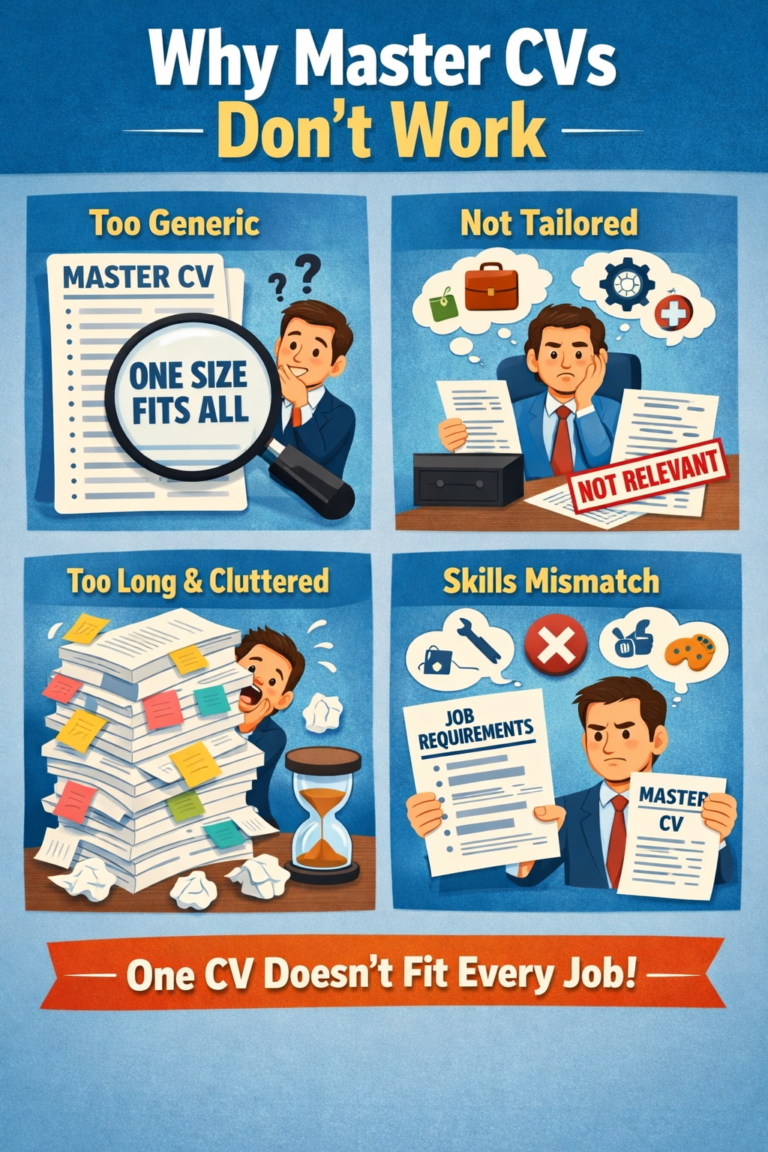
| 1 | Using a generic CV for every application | ATS scores your match to that specific job description. A generic CV scores low on every one | Tailor keywords and summary for each role |
| 2 | Two-column layout | Parsers read left-to-right and top-to-bottom. Columns get scrambled or skipped | Switch to single-column format |
| 3 | Uploading a PDF instead of DOCX | PDF formatting breaks during ATS ingestion across all regional portals. Dates, titles, and skills frequently misparse | Use DOCX for every portal |
| 4 | Not filling in portal profile fields | Bayt and Naukri score profile completeness separately from your CV. Incomplete profiles rank lower | Complete every profile section after uploading your CV |
| 5 | Paraphrasing instead of mirroring keywords | Regional ATS uses literal matching. “led cross-functional teams” is not the same as “managed teams across departments” | Copy exact phrases from the job description |
| 6 | Missing skills tags on Naukri and Bayt | Skills in the portal’s tags field are scored separately. A great CV without tags still ranks lower | Add skills tags manually in your portal profile |
| 7 | No visa / nationality information (UAE roles) | Recruiters on Bayt and GulfTalent filter by nationality and visa status constantly. Missing this means being filtered out | Add nationality, visa type, and current emirate to your CV and profile |
Before & after: what ATS optimisation actually looks like
Here’s the same experience bullet point written two ways: one that fails ATS and one that passes.
Before: ATS fail
“Responsible for looking after the company’s money and making sure the books were right at the end of each month. Worked closely with the leadership team to make decisions about spending.”
After: ATS optimised
“Financial reporting and P&L management across a 3-entity group. Delivered month-end close within 5 business days. Collaborated with C-suite on budgeting and cost optimisation, achieving 12% reduction in operational expenditure.”
Before: ATS fail
“Helped with building software products from start to finish. Was part of a team that used modern tools to write code and check it worked properly.”
After: ATS optimised
“Full-stack development using React, Node.js, and PostgreSQL. Delivered 4 production features per sprint in an agile environment. Reduced API response time by 35% through caching and query optimisation.”
The “after” versions do three things: they use the exact keyword phrases recruiters search for, they include quantified results, and they match the language of real job descriptions in their field.
Your ATS-ready CV checklist
Before submitting any application on a regional portal, run through this list.
- Single-column layout with standard section headings No tables, text boxes, graphics, or two-column designs
- Keywords mirrored exactly from the job description Not paraphrased. Literal match where possible
- Skills section populated with tags from the job posting Both in the CV body and in the portal’s skills tag field
- File format matched to the portal DOCX for every portal. PDF formatting breaks during ATS ingestion
- Portal profile fields fully completed Headline, summary, current role, education. Aim for 100% completeness score
- Nationality and visa status included (UAE roles) These are active recruiter filters on Bayt and GulfTalent
- Current location set to emirate level (UAE roles) Proximity boosts ATS ranking for local roles
- Quantified achievements in experience bullets Numbers, percentages, and outcomes dramatically improve both ATS score and human readability
- No photos, graphics, or decorative elements in CV body These cause parsing failures across all regional portals
- Contact details in plain text in the main body Not in headers, footers, or text boxes
This checklist needs to be repeated for every single application, because every job description has different keywords. Doing this manually for 100 applications would take weeks. ApplyIn5 generates a fully ATS-optimised, tailored CV for each application automatically. You review and submit in 5 minutes.
Frequently asked questions
- Do all companies in UAE and India use ATS?
- Not all. Smaller companies and family businesses often review CVs manually. But any company using Bayt, GulfTalent, Naukri, or LinkedIn as their primary hiring channel is running applications through those platforms’ built-in ATS scoring systems, whether they know it or not. For roles at multinationals, large regional companies, and banks, dedicated ATS tools are standard.
- Should I use the same CV for Bayt and Naukri?
- No, and not just because the portals work differently. You should be tailoring your CV to each individual job description regardless of platform. The keywords that matter for a finance role at an Abu Dhabi bank are not the same as for a tech role at a Bangalore startup. Generic CVs perform poorly on both portals.
- Does including a photo hurt my ATS score in UAE?
- Photos don’t hurt your ATS score directly, but placing a photo in your CV body can cause the parser to scramble surrounding text, which does hurt your score. If you want to include a photo (which is common and acceptable in Gulf markets), add it in the portal’s profile picture field, not embedded in your CV document.
- How often should I update my Naukri profile?
- At minimum every 2 to 3 weeks while actively job hunting. Naukri’s algorithm actively promotes recently modified profiles in search results. You do not need to change your actual content. Even re-saving with a minor edit will refresh the “last modified” timestamp and boost your visibility.
- What’s the difference between ATS optimisation and keyword stuffing?
- Keyword stuffing means listing keywords without context, producing a wall of buzzwords that reads as incoherent to a human. ATS optimisation means integrating the right keywords naturally into well-written bullet points and summaries, so the content passes the algorithm and still reads well to the recruiter who opens it. The goal is to pass both filters: machine and human.
- Can ApplyIn5 handle the ATS optimisation for me?
- Yes. That’s exactly what it does. When you apply to a job through ApplyIn5, the AI reads the job description, identifies the relevant keywords and phrases, and generates a tailored CV that mirrors that language, drawing on your actual experience and achievements. It then auto-fills the application form, including skills tags and profile fields. You review the output and submit in 5 minutes.
Apply smarter. Get hired faster.
ApplyIn5 automatically generates an ATS-optimised, keyword-matched CV for every application, across Bayt, Naukri, GulfTalent, LinkedIn, and 100+ more portals.
Apply in 5 minutes and get hired today →