

UAE Job Search Guide
The UAE Expat Job Search Playbook: From Visa to Offer (2026)
A complete, step-by-step guide for expats relocating to the UAE or searching for work while already in the country. Covers visa types, which portals to use, how Gulf employers read CVs, salary negotiation, and how to compress your timeline from months to weeks.
The UAE is home to over 11 million people, of whom roughly 88 to 89% are expats. Emirati nationals account for only 11 to 12% of the population. That makes the UAE one of the most internationally diverse and competitive hiring environments on the planet, with one of the highest job turnover rates in the world. That means opportunities are constant, but competition is intense and the rules are different from Western job markets. This guide walks you through every stage: understanding your visa options, building a UAE-specific CV, choosing the right portals, managing the application volume required to actually get interviews, and negotiating an offer that accounts for the unique structure of UAE compensation packages.
- The reality of the UAE job market in 2026
- Visa types and what they mean for your job search
- How to write a UAE-specific CV
- Which portals to use and when
- The volume problem: why most expats apply too few times
- Networking in the UAE: how it actually works
- What to expect in UAE job interviews
- How to answer behavioural questions: the STAR format
- Understanding UAE compensation packages
- A week-by-week search timeline
- Frequently asked questions
The reality of the UAE job market in 2026
The UAE job market is unlike almost any other in the world. The country has a total population of just over 11 million, of whom roughly 88 to 89% are expats. Emirati nationals make up only 11 to 12%. Your CV sits alongside applicants from India, Pakistan, the Philippines, the UK, Egypt, Lebanon, and dozens of other countries, all competing for the same roles.
The good news is that turnover is equally high. Expat contracts typically run two to three years, visa-linked employment creates natural churn, and the UAE’s growth across finance, tech, real estate, logistics, and healthcare generates a steady stream of new roles. If you approach the search strategically, the market rewards persistence.
What it does not reward is the Western approach of sending a handful of polished applications and waiting. The sheer volume of applicants means recruiters move fast, posting windows are short, and a candidate who applies on day one of a listing has a meaningfully better chance than one who applies on day five.
The sectors actively hiring in 2026 are technology (particularly AI, fintech, and cybersecurity), financial services, real estate, healthcare, logistics and supply chain, and hospitality. The UAE’s push toward a knowledge economy under Vision 2031 is creating demand for skilled professionals that local talent supply cannot meet, which is precisely why expat hiring remains robust.
Visa types and what they mean for your job search
Your visa status shapes your entire job search strategy in the UAE. It affects which roles you can apply for, how urgently you need to secure an offer, and how recruiters perceive you. Understanding the options before you start searching is not optional.
The main visa categories for job seekers
| Visa type | Duration | Job search implications | Best for |
|---|---|---|---|
| Employment visa (sponsored) | 2 to 3 years, renewable | Tied to employer. Changing jobs requires NOC or new visa process. Most common path for expats | Anyone with a confirmed offer |
| Visit visa (job seeker) | 30 to 90 days, extendable | Being in-country significantly improves callback rates. Recruiters prefer locally available candidates | Applicants relocating to search in person |
| Green visa (self-sponsored) | 5 years | No employer tie, full job search flexibility, highly attractive to recruiters | Skilled professionals, freelancers, investors |
| Golden visa | 10 years | Maximum flexibility. Signals very senior or high-value profile to employers | Exceptional talent, entrepreneurs, investors |
| Freelance permit | 1 to 3 years | Allows contract and project work while searching for full-time employment | Those wanting to earn while searching |
Being physically present in the UAE when you apply makes a significant difference. Many UAE recruiters and hiring managers explicitly filter for candidates who are already in-country, especially for roles requiring quick starts. If you are applying from outside the UAE, your cover letter and CV should address your relocation plan and timeline directly. If you can afford a 30 to 60 day visit visa trip to search in person, it will shorten your search materially.
Changing jobs on an employment visa
If you are already employed in the UAE and looking to move, the process became significantly simpler after the 2022 labour law reforms. You can now change employers after completing six months of service without requiring a No Objection Certificate (NOC) from your current employer in most cases. The new employer initiates the visa transfer. Always verify current rules with the Ministry of Human Resources as regulations continue to evolve.
How to write a UAE-specific CV
A UAE CV is not the same as a Western one. The conventions are different, and submitting a standard UK or US-format CV to a Gulf employer without adapting it is one of the most common and costly mistakes expat job seekers make.
What a UAE CV must include that a Western CV does not
- Nationality. Gulf employers and their ATS systems use nationality as a filter. Include it in your personal details section. This is standard practice and expected, not discriminatory in the local context
- Visa status. State clearly whether you are on a visit visa, employment visa, green visa, or applying from outside the UAE. Recruiters ask this in their first message if you do not include it, which slows everything down
- Current UAE location if applicable, at emirate level. Dubai, Abu Dhabi, and Sharjah are the primary hiring markets. Being local to the role matters
- UAE driving licence if you hold one and it is relevant to the role. Many job descriptions list this as a requirement or preference, and it is an active filter on Bayt and GulfTalent
- A professional photo is common and acceptable in Gulf CV culture, unlike in many Western markets. If you include one, use a professional headshot and embed it in your DOCX file rather than as a floating image that can displace text
Length and format
Two pages is the standard for most roles in the UAE. Senior professionals with ten or more years of experience can go to three pages, but anything beyond that will not be read. Keep to a clean single-column DOCX layout. Recruiters in the Gulf handle extremely high application volumes and a CV that requires effort to read will simply be skipped.
How Gulf employers read a CV differently
Western recruiters are trained to look for impact and quantified achievements. Gulf recruiters do too, but they also pay close attention to a few additional signals that are less prominent in Western hiring culture:
- Company brand recognition. Where you worked matters as much as what you did. Having a recognised multinational, a regional bank, or a major UAE or GCC company in your experience section opens doors that a purely achievements-focused CV may not
- Stability and tenure. Frequent job changes raise red flags more quickly in Gulf hiring culture than in Western markets. Less than one year at multiple consecutive employers requires explanation
- Relevant geography. Previous UAE or GCC experience is a strong positive signal. If you have it, make it prominent. If you do not, address your understanding of the Gulf market explicitly in your cover letter
- Educational qualifications. Degree credentials are weighted heavily in the Gulf, particularly in finance, engineering, law, and medicine. Make sure your educational background is clearly stated and prominently positioned
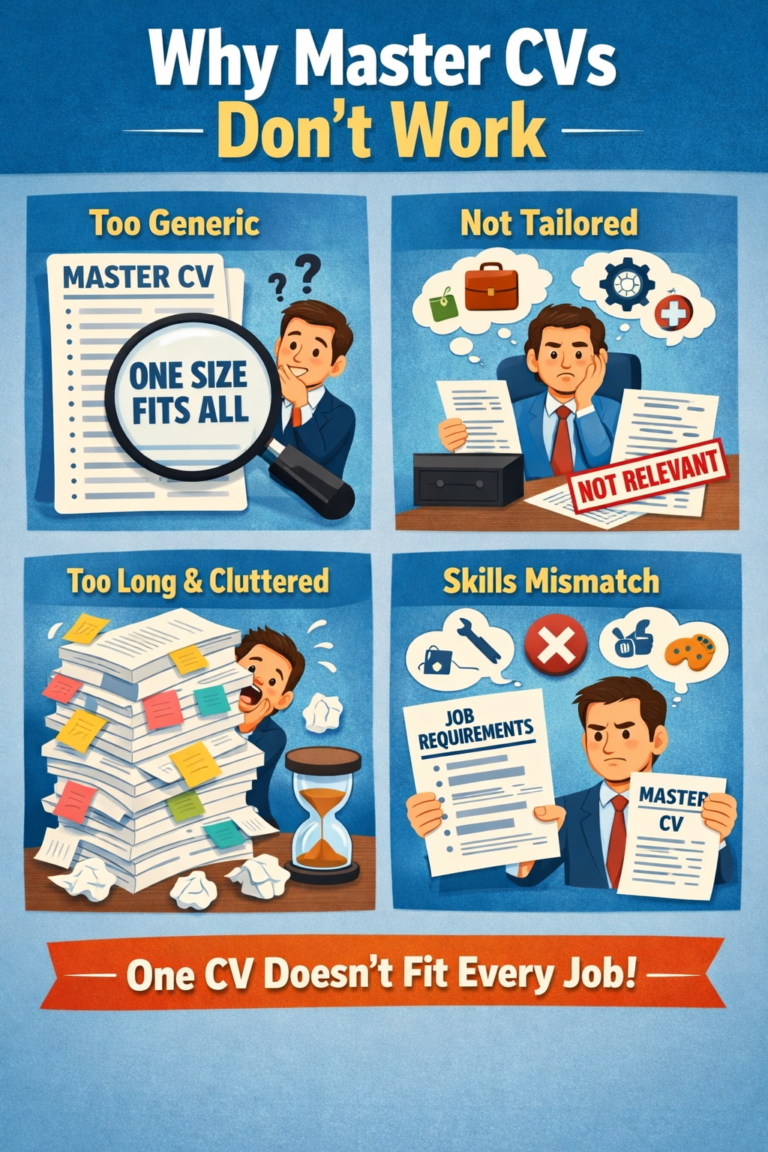
The single most effective thing you can do is tailor your CV to each individual job description: mirror its keywords, lead with the experience most relevant to that role, and adjust your professional summary to speak directly to what that employer is looking for. This is time-consuming to do manually for every application, which is exactly the problem ApplyIn5 solves.
Which portals to use and when
The UAE job market is fragmented across several portals, each with its own audience, recruiter base, and best use case. Using all of them is not the right strategy. Using the right ones strategically is.
- The dominant portal for UAE and GCC white-collar jobs
- Strongest for finance, admin, sales, marketing, HR, and operations roles
- Recruiter base skews toward regional companies and multinationals with Gulf offices
- Profile completeness score heavily affects your ranking in recruiter search results
- Should be your first account and the one you maintain most actively
- Essential for networking and direct recruiter outreach, not just job postings
- Stronger for technology, consulting, finance, and senior roles than Bayt
- Many UAE roles are filled through LinkedIn DMs before they are formally posted
- Recruiter InMails have 10 to 18% response rates for well-matched profiles
- Invest in a strong headline, About section, and skills endorsements
- More curated than Bayt, with a stronger focus on mid to senior professional roles
- Recruiter quality tends to be higher, with fewer low-quality or outdated listings
- Strong for engineering, oil and gas, healthcare, and senior management
- Lower application volumes per listing than Bayt, improving callback rates
- Worth maintaining an active profile alongside Bayt
- Aggregates listings from company career pages and other portals
- Good for catching roles that are not posted on Bayt or GulfTalent
- Particularly strong for hospitality, retail, logistics, and SME roles
- Application quality expectations are lower, which can work in your favour
- Use as a supplementary source, not a primary channel
- Originally a classifieds platform, now a legitimate job board for UAE roles
- Skews toward SMEs, startups, and roles requiring UAE-based candidates
- Lower competition per listing than Bayt, particularly for mid-level roles
- Worth a weekly check if you are open to smaller companies
- Major UAE employers (ADNOC, Emirates, Emaar, ADCB, FAB, DP World) post roles on their own sites that never appear on job portals
- Applying directly signals genuine interest and avoids ATS competition from portal aggregation
- Set up job alerts on the careers pages of your top 10 to 15 target companies
- Worth the extra effort for roles at companies where you have a strong match
ApplyIn5’s Chrome extension activates automatically on Bayt, GulfTalent, Indeed Gulf, Dubizzle Jobs, LinkedIn, and 100+ other portals. It generates a tailored CV and cover letter for each role and fills the application form in seconds, regardless of which portal you are on.
The volume problem: why most expats apply too few times
This is the section most job search guides skip, and it is arguably the most important one. The majority of expats searching for work in the UAE send between 15 and 30 applications and consider that a serious effort. By the numbers, it is not.
With a typical callback rate of 3 to 5% on UAE job portals, sending 20 applications gives you roughly a 50 to 65% probability of receiving even a single interview invitation. That means roughly one in three people doing what feels like a thorough search will hear nothing back through no fault of their own. The issue is not their CV or their experience. It is pure statistics.
To have a 95% probability of landing at least five interviews, enough to give you real choices, you need to send 80 to 120 tailored applications. Most people never get close to that number because at 20 to 45 minutes per application, it represents 40 to 90 hours of form-filling work on top of researching roles, preparing for interviews, and managing the emotional weight of a job search.
ApplyIn5 reduces each application from 20 minutes to 5 minutes. That means 100 applications takes 8 hours instead of 35 hours. You spend that time reviewing applications and preparing for interviews rather than copying your employment history into form fields for the hundredth time. Read the full application math breakdown here.
Networking in the UAE: how it actually works
Networking in the UAE operates differently from the West in ways that catch many new expats off guard. Understanding the social dynamics before you arrive will save you a lot of wasted effort.
The referral advantage is enormous
A referral from inside a UAE company can increase your application callback rate from 3 to 5% to 20 to 30%. This is not unique to the Gulf, but the degree to which personal relationships and trusted introductions drive hiring decisions here is more pronounced than in most Western markets. If you know someone at a company you want to join, that connection is worth more than hours of optimising your CV.
Where UAE professional networking actually happens
- LinkedIn is the most effective digital channel for professional outreach in the UAE. Connection request acceptance rates are relatively high compared to other markets, and a short, personalised message to a hiring manager or team lead is often enough to get your application noticed
- Industry events and meetups in Dubai and Abu Dhabi are genuinely useful. Sectors like technology, finance, and real estate have active professional communities with regular events. Eventbrite, Meetup, and LinkedIn Events surface most of them
- Recruitment agencies are a significant channel in the UAE in a way they have diminished in many Western markets. Agencies like Robert Half, Michael Page, Hays, Charterhouse, and Korn Ferry actively place professionals in the Gulf. Register with two or three relevant to your sector
- Expat communities both online (Facebook groups like “UAE Jobs and Networking” have hundreds of thousands of members) and offline are surprisingly effective job search channels, particularly for roles at smaller companies that do not have large recruitment budgets
Cold outreach that actually works
Reaching out directly to hiring managers or department heads on LinkedIn is more accepted in UAE business culture than in many other markets. Keep your message short (three to four sentences), specific about the role or team you are interested in, and focused on what you bring rather than what you need. A connection request with a personalised note, followed by a brief message if accepted, is the most effective sequence.
What to expect in UAE job interviews
UAE interview processes vary widely by company type, sector, and the seniority of the role, but there are patterns worth knowing before your first call.
The typical interview process
Most UAE employers run two to four interview rounds. The first is almost always a phone or video screening with HR or a recruiter, lasting 20 to 30 minutes and focused on background, availability, and salary expectations. The second round typically involves the direct hiring manager or a technical assessment. Senior roles often include a panel interview and sometimes a presentation or business case exercise.
Questions to prepare for
- “What is your current salary and what are your expectations?” This is asked early and directly in UAE interviews. Have a specific number ready, not a range. Research market rates for your role and level in advance using Bayt’s salary survey, GulfTalent’s compensation reports, or LinkedIn Salary Insights
- “Why do you want to work in the UAE?” Be specific. Mentioning career growth, the international environment, and your long-term commitment to the region lands better than vague answers about lifestyle
- “How soon can you join?” UAE employers move fast when they want someone. Having a clear and honest answer here is important. If you are on a visit visa with 30 days remaining, say so. If you need 30 to 60 days notice at your current role, say so
- Standard behavioural questions using the STAR format apply as they would anywhere. See the dedicated STAR section below for how to prepare these answers properly
Culture and conduct
Punctuality is taken seriously. Dress formally for in-person interviews regardless of the company’s day-to-day dress code. Titles and seniority are respected in Gulf business culture, particularly in more traditional sectors like banking, government-linked companies, and real estate. First-name informality is fine in tech startups but not universal.
How to answer behavioural questions: the STAR format
Behavioural interview questions are used consistently across UAE employers, from startups to global banks. They ask you to describe a past situation to predict how you will behave in future ones. The most common format for answering them is STAR: Situation, Task, Action, Result.
Most candidates know what STAR stands for. Far fewer actually use it well under pressure. Here is how to prepare answers that land.
The four components
| Letter | What it means | What to include | Common mistake |
|---|---|---|---|
| S: Situation | The context and background | One to two sentences. Set the scene without over-explaining. Company size, team context, timeline if relevant | Spending too long here. The situation is just context, not the story |
| T: Task | Your specific responsibility | What you personally were responsible for. Not what the team faced, what YOU were accountable for | Describing the team’s challenge instead of your individual role. Interviewers want to know what you did |
| A: Action | What you specifically did | The steps you took, the decisions you made, the approach you chose. This is the longest and most important part of the answer | Being vague (“I coordinated with stakeholders”) instead of specific (“I ran weekly syncs with three department heads and created a shared tracker to resolve the bottleneck”) |
| R: Result | What happened because of your actions | Quantify wherever possible. Numbers, percentages, timelines, cost savings, revenue impact. If you cannot quantify, describe the qualitative outcome clearly | Skipping this entirely or ending with “it went well”. The result is what the interviewer remembers |
Common UAE behavioural questions to prepare
Write out a full STAR answer for each of these before your first interview. Having them prepared means you are never caught searching for an example on the spot.
- “Tell me about a time you had to manage a difficult stakeholder or client.”
- “Describe a situation where you had to deliver results under significant pressure or with a tight deadline.”
- “Give me an example of a time you identified a problem and took initiative to solve it.”
- “Tell me about a time you had to adapt to a major change at work.”
- “Describe a situation where you had to work with people from very different cultural backgrounds.” This is particularly common in UAE interviews given the diversity of the workforce.
- “Tell me about a time you made a mistake. What happened and what did you learn?”
You do not need a different story for every possible question. A good STAR story can be adapted to answer three or four different questions depending on which aspect you emphasise. Prepare six to eight solid examples covering leadership, pressure, problem-solving, stakeholder management, conflict, and failure. That bank of stories will cover most of what you get asked.
Understanding UAE compensation packages
UAE salaries are structured very differently from Western compensation packages, and misunderstanding this structure is one of the most common negotiation mistakes expats make. Your “salary” in the UAE is typically just one component of a total compensation package that includes several additional elements. As a starting point on all-in monthly figures for 2026: juniors (0 to 3 years) typically earn AED 4,000 to AED 8,000, mid-level professionals (4 to 8 years) earn AED 10,000 to AED 30,000, and senior managers to directors earn AED 40,000 to AED 80,000 and above. Note that nationality plays a real role in these figures: Western passport holders are routinely offered higher packages for comparable roles. This is an uncomfortable truth but a practical one worth understanding before you negotiate.
The components of a UAE package
| Component | What it is | Notes |
|---|---|---|
| Basic salary | The core monthly salary figure | Used to calculate end-of-service gratuity. Higher basic = more valuable overall package |
| Housing allowance | Monthly or annual allowance toward rent | Often 25 to 40% of total comp. Can be paid monthly or as a lump sum annually |
| Transport allowance | Monthly allowance for commuting costs | Ranges widely, typically AED 1,000 to AED 3,000 per month |
| Medical insurance | Health coverage for employee (and sometimes family) | Mandatory by law. Quality varies enormously. Check whether it covers dependents |
| Annual leave | Paid vacation days per year | Legal minimum is 30 calendar days after one year. Senior roles often offer more |
| End-of-service gratuity | Lump sum paid on leaving the company | 21 days of basic salary per year of service for the first 5 years, 30 days per year thereafter. Only calculated on basic salary |
| Annual flight ticket | Return ticket to home country per year | Standard at many companies, especially for professional roles. Worth asking about |
| Education allowance | School fees for children | Rare except at senior levels or multinational firms. Very valuable given Dubai school fees |
When an offer comes in, do not focus only on basic salary. A higher housing allowance, better medical coverage that includes dependents, or an annual flight ticket can each be worth tens of thousands of dirhams per year. Ask for the full breakdown before accepting or declining any offer, and always compare total compensation rather than basic salary figures alone.
Tax-free income: the context that matters
The UAE has no personal income tax. A salary of AED 25,000 per month in Dubai is AED 25,000 in your pocket. When comparing UAE compensation to a role in the UK, Australia, or the US, you need to gross up the UAE figure by the marginal tax rate you would pay at home to make an apples-to-apples comparison. For most mid to senior professionals this makes UAE compensation more competitive than the raw number suggests.
A week-by-week search timeline
A UAE job search takes longer than most people expect, and it is better to know this upfront than to be blindsided halfway through. Getting your first interview call typically takes four to eight weeks from when you start applying seriously. By the time you clear multiple interview rounds and reach offer and negotiation stage, a realistic total timeline is three to four months. This is the norm, not a sign that something is wrong. Plan your finances and your visa timeline accordingly.
Foundation and setup
Do not send a single application until this is done. Rushing to apply before your infrastructure is ready wastes your most important window.
- Write your UAE-format CV in DOCX with nationality, visa status, photo, and local contact details
- Create and fully complete profiles on Bayt and GulfTalent. Aim for 100% completeness on both
- Optimise your LinkedIn profile with a strong headline, About section, and skills
- Write a flexible cover letter template that you will customise for each role
- Identify your top 20 target companies and set up job alerts on their career pages
- Register with two or three recruitment agencies relevant to your sector
High-volume application push
This is the longest and most important phase. New listings get the most recruiter attention in the first 48 to 72 hours, so applying early and consistently is critical. Most candidates will not receive their first interview call until four to six weeks into this phase. That is normal. Do not slow down or pivot strategy because of early silence.
- Target 15 to 20 applications per day across Bayt, GulfTalent, LinkedIn, and Indeed Gulf
- Tailor each CV and cover letter to the specific job description using ApplyIn5
- Send 5 to 10 personalised LinkedIn connection requests per day to hiring managers and team leads at target companies
- Track every application in a simple spreadsheet: date, company, role, portal, status
- Follow up on applications older than one week with a brief, polite note to the recruiter
- Keep applying even as first callbacks start coming in. Pipeline depth protects you
Interview rounds
UAE interview processes are slow by most standards. A typical process runs two to four rounds, and weeks can pass between each one while companies align internal schedules, bring in additional interviewers, or simply deprioritise the hire temporarily. Ghosting after one or two rounds is not uncommon. Stay patient and keep your pipeline active throughout.
- Research each company thoroughly before every call, including recent news, leadership, and the specific team you are interviewing with
- Prepare your STAR-format answers for the six most common behavioural questions before your first HR screen
- Have a specific salary expectation number ready. UAE interviewers ask this early and directly
- Continue applying at a steady cadence (5 to 10 per day) even while interviewing. Do not stop until you have a signed offer
- Follow up after every round within 24 hours with a brief thank-you and reiteration of your interest
- Attend at least one in-person industry event or meetup to deepen your network in parallel
Final rounds, offer, and negotiation
By this stage you may have multiple processes running at different speeds. That is ideal. Having more than one active final round gives you genuine negotiating leverage and protects you from the disappointment of a single process falling through at the last stage.
- Request the full compensation breakdown in writing before any verbal acceptance
- Negotiate on total package, not just basic salary. Housing allowance, medical coverage, and flight tickets are all negotiable
- If you have multiple offers or competing final rounds, it is acceptable to tell one employer you are considering another offer and need a decision timeline
- Confirm start date, visa sponsorship process, and probation terms in writing before signing
- Factor in two to four weeks for the visa transfer or new visa issuance after your start date is agreed
- Notify recruitment agencies and withdraw from active applications once you have a signed written offer in hand
Even after signing an offer, the UAE employment visa process typically takes two to four weeks. If you are relocating from outside the country, add time for travel and accommodation setup. A start date four to six weeks from offer acceptance is entirely normal. Budget for three to four months without income if you are searching from a visit visa. This is the realistic cost of a UAE job search and planning for it removes the financial pressure that leads people to accept the wrong offer.
Frequently asked questions
- How long does a UAE job search realistically take?
- Three to four months is the realistic expectation for most mid-level professional roles in the UAE, from first application to signed offer. Getting your first interview call typically takes four to eight weeks. Interview processes then run two to four rounds over several more weeks. Senior positions often take four to six months. The biggest variable is application volume: candidates who apply consistently and at scale from the start compress this timeline meaningfully compared to those who send a handful of applications and wait.
- Is it better to search for a UAE job from inside the country or before arriving?
- Being in-country is a genuine advantage. Many UAE employers explicitly prefer candidates who are immediately available and locally based, particularly for roles requiring a quick start. If you can afford a 30 to 60 day visit to search in person, it typically shortens the process. That said, plenty of roles are filled with overseas candidates, particularly for senior or specialised positions where the talent pool is smaller. If you are applying from outside the UAE, always state your visa plan and relocation timeline clearly in your CV and cover letter.
- Do I need to speak Arabic to find a good job in the UAE?
- For the vast majority of professional roles in the private sector, no. English is the primary business language across finance, technology, real estate, logistics, and most multinational operations. Arabic fluency is an advantage for client-facing roles at local or government-linked companies, government sector positions, and roles requiring engagement with Emirati stakeholders. It will never hurt your candidacy, but it is not a prerequisite for most expat professionals.
- What is a realistic salary expectation for professional roles in Dubai?
- This varies by sector, seniority, company size, and, frankly, nationality. As a rough benchmark in 2026: junior professionals (0 to 3 years experience) typically earn AED 4,000 to AED 8,000 per month all-in. Mid-level professionals (4 to 8 years) typically see AED 10,000 to AED 30,000 all-in. Senior managers and directors range from AED 40,000 to AED 80,000 and above. It is worth knowing that nationality affects pay in the UAE more visibly than in most markets. Western passport holders are frequently offered higher packages for equivalent roles compared to South Asian, Southeast Asian, or African candidates. This is a documented reality of the Gulf labour market, not a rumour. Use Bayt’s annual salary survey and GulfTalent’s compensation reports for sector-specific benchmarks, and speak to people in your field who are already based in the UAE for the most accurate read on what your specific profile commands.
- How do I explain a gap in employment on a UAE CV?
- Address it briefly and directly in your cover letter. UAE employers are not significantly more judgmental about gaps than employers elsewhere, but they do notice unexplained ones. A short explanation (relocation, caregiving, health, upskilling, freelance work) is enough. Do not try to hide a gap by fudging dates. Recruiters verify employment history and discovering a discrepancy at the reference stage is far more damaging than the gap itself.
- Should I use a recruitment agency or apply directly?
- Both, simultaneously. Recruitment agencies in the UAE are more active and more effective than in many Western markets. A good agency consultant who specialises in your sector can get your CV in front of hiring managers who never post roles publicly. At the same time, direct applications to Bayt, LinkedIn, and company career pages should be running in parallel. Relying on agencies alone is too slow. Relying on direct applications alone means missing roles that are only filled through agencies.
Join the movement. Apply smarter, get hired faster.
ApplyIn5 cuts every job application from 20 minutes to 5, on Bayt, GulfTalent, LinkedIn, and 100+ UAE and India portals. Stop filling forms. Start getting interviews.
Apply in 5 minutes and get hired today →