
Create one killer master CV, polish it to perfection, and send it to every job you apply for. Efficient, consistent, professional.
There’s just one problem. That worked back in 2015. In 2026, that approach is dead.
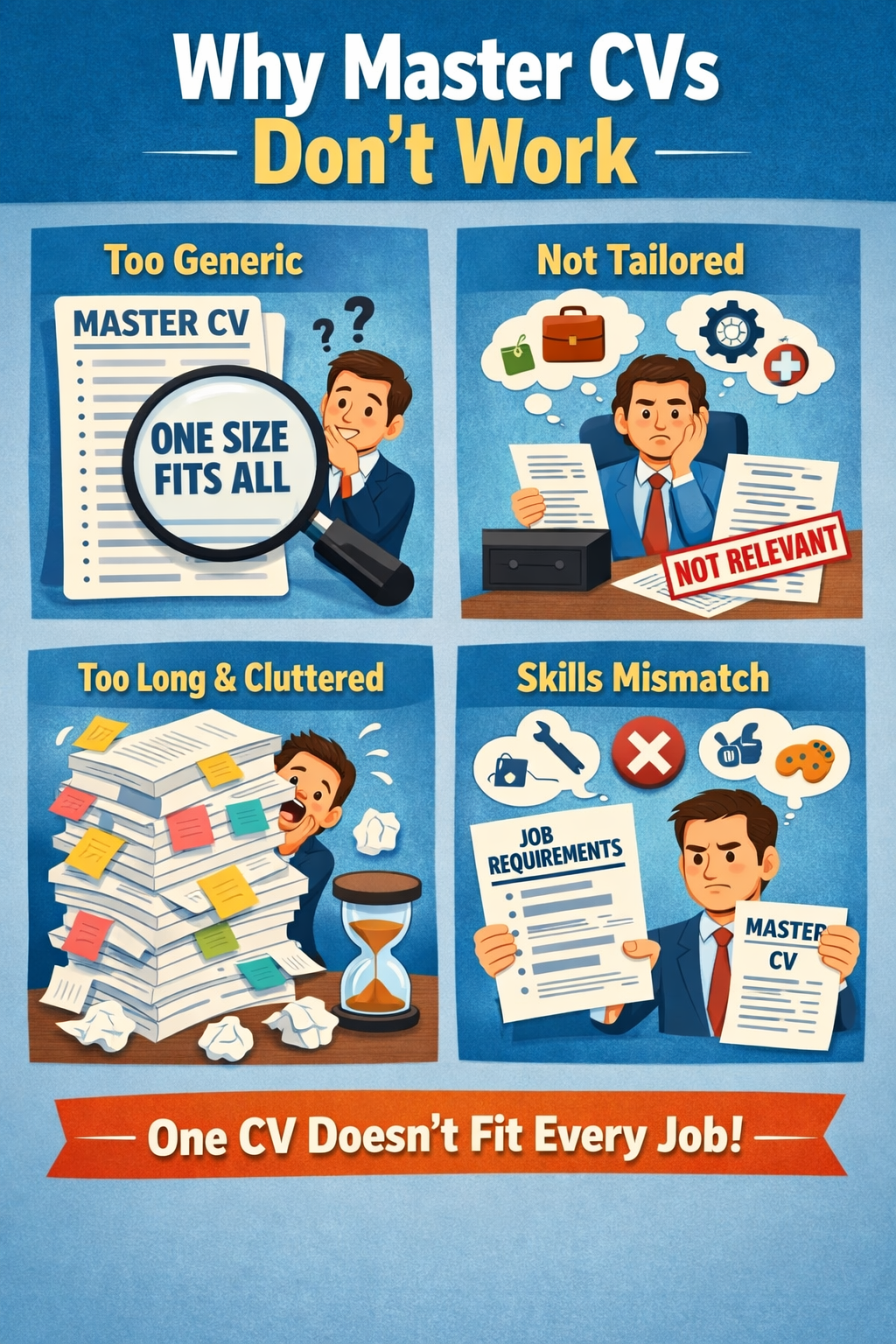
The job market has fundamentally changed, and the master CV approach has become the fastest way to guarantee rejection.
The data doesn’t lie: 63% of recruiters want to receive resumes tailored to the specific position they’re hiring for. Yet 90% of candidates still submit generic, one-size-fits-all resumes. This massive disconnect explains why so many qualified candidates are being filtered out before anyone even reads their application.
If you’re sending the same resume to every job and wondering why you’re not getting callbacks, here’s your answer: You’re competing in a 2026 job market with a 2015 strategy.
The Death of the Master CV: What Changed?
The ATS Arms Race
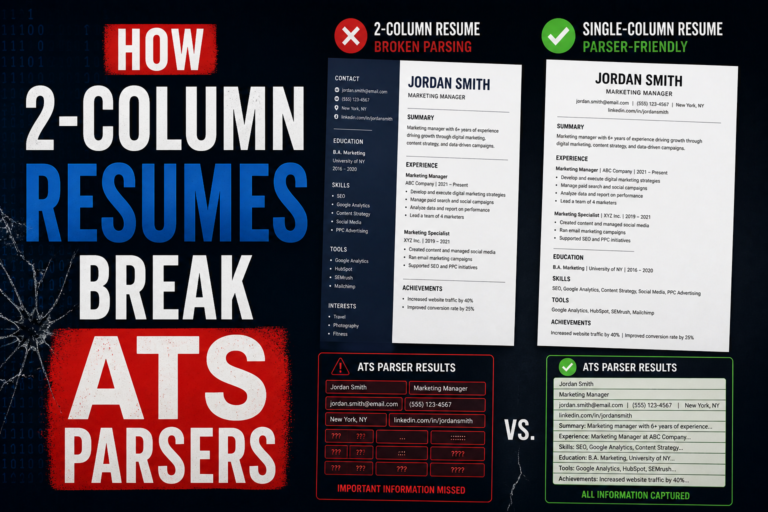
First, let’s talk about the elephant in the room: Applicant Tracking Systems.
75% of resumes are rejected by ATS software before a human ever sees them. But here’s what’s changed in 2026: These systems aren’t just looking for keywords anymore. They’re using AI to analyze how well your entire resume matches the specific job description.
Your master CV might mention “project management” once. The job description mentions it five times and adds specific requirements like “Agile methodology,” “cross-functional team leadership,” and “stakeholder communication.”
The ATS scores your resume at 30% match. You’re filtered out.
The candidate who tailored their resume to emphasize their Agile project management experience? They score 85% and move forward.
The Recruiter Reality: 6 seconds
Even if your generic resume somehow passes the ATS filter, it still has to survive the human screening process.
And here’s the brutal truth: Recruiters spend an average of 6-8 seconds reviewing each resume.
Six seconds.
In that tiny window, they’re not looking for a “generally qualified candidate.” They’re scanning for specific proof that you can solve their exact problem. Your master CV, trying to appeal to everyone, appeals to no one.
As one recruiter put it: “If I have to expend an unreasonable amount of brain calories to figure out if you are good, then you aren’t.”
Skills-First Hiring Has Become Standard
The final nail in the master CV’s coffin: 43% of businesses now make skills-first hiring their top priority.
This means hiring managers care less about where you went to school or your complete employment history. They want to see evidence that you possess the specific skills needed for this particular role.
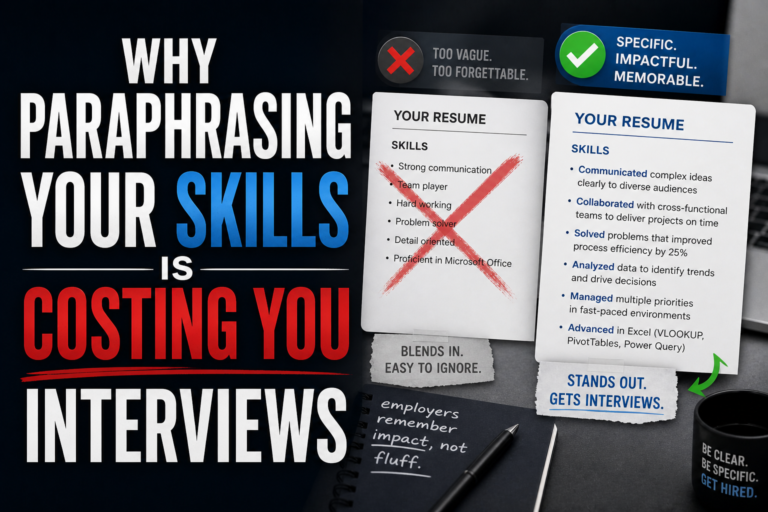
Your master CV lists 20+ skills. The job needs 8 specific ones. Which resume wins: yours with everything listed generically, or the tailored one that highlights exactly those 8 skills with relevant examples?
It’s not even a fair fight.
Why Master CVs Feel Like They Should Work (But Don’t)
I get it. The master CV approach makes logical sense:
The Master CV Promise:
- Create one perfect version
- Maintain consistency across applications
- Save massive amounts of time
- Apply to more jobs faster
The Master CV Reality:
- Gets filtered by ATS because keywords don’t match
- Looks generic and unfocused to recruiters
- Signals you didn’t care enough to customize
- Lower response rate means you waste MORE time, not less
Here’s the ironic part: Candidates using master CVs end up sending 2-3x more applications to get the same number of interviews as those who customize.
So who’s actually being more efficient?
The “But Customization Takes Too Much Time” Myth
The biggest objection I hear is: “If I customize every resume, I’ll never have time to apply to enough jobs.”
Let’s do the math.
Scenario A: Master CV Approach
- Application time: 15 minutes per job
- Applications needed per interview: 50 (assuming 2% success rate)
- Total time to get 1 interview: 750 minutes (12.5 hours)
- Applications needed for 5 interviews: 250
- Total time: 3,750 minutes (62.5 hours)
Scenario B: Customized Resume Approach
- Application time: 25 minutes per job (includes 10-minute customization)
- Applications needed per interview: 33 (assuming 3% success rate—conservative estimate)
- Total time to get 1 interview: 825 minutes (13.75 hours)
- Applications needed for 5 interviews: 165
- Total time: 4,125 minutes (68.75 hours)
Wait, customization actually takes MORE time?
Yes. But you’re applying to 85 fewer jobs. And here’s what that math doesn’t capture:
The Quality Factor:
- Tailored applications get faster responses
- Better interview conversion means fewer total interviews needed
- Higher offer rates mean less time negotiating with multiple employers
- Less rejection means better mental health and sustained motivation
The real efficiency gain isn’t time per application. It’s total time to job offer.
What Tailoring Actually Means (You Don’t Start from Scratch)
Here’s the critical misconception: Tailoring doesn’t mean rewriting your entire resume for every job.
What it actually means:
1. Keyword Alignment (2-3 minutes)
Scan the job description for critical terms and phrases. Ensure these appear naturally in your resume, especially in:
- Professional summary
- Skills section
- Job titles and descriptions
2. Experience Prioritization (3-4 minutes)
Reorder bullet points under each role to lead with the most relevant achievements for this specific job. You’re not inventing new content—you’re strategically emphasizing what matters most.
3. Skills Section Optimization (1-2 minutes)
From your comprehensive master list, select the 10-15 skills most relevant to this position. Put the job’s required skills at the top.
4. Summary Customization (2-3 minutes)
Adjust your professional summary to mirror the job title and key requirements. Change “Marketing professional with diverse experience” to “Growth Marketing Specialist with proven SaaS acquisition expertise.”
Total customization time: 10-12 minutes per application.
The Master-Tailored Hybrid System That Actually Works
Here’s what successful job seekers do in 2026:
Step 1: Build a Comprehensive Master Document
Create one massive document that includes:
- Every job you’ve held with 10-15 bullet points each
- Every skill you possess (30-50 skills)
- Every certification, achievement, and project
- Multiple versions of your professional summary
- All education and training
This isn’t your resume. It’s your content database.
Step 2: Create a Base Template
Develop one well-formatted, ATS-friendly template with:
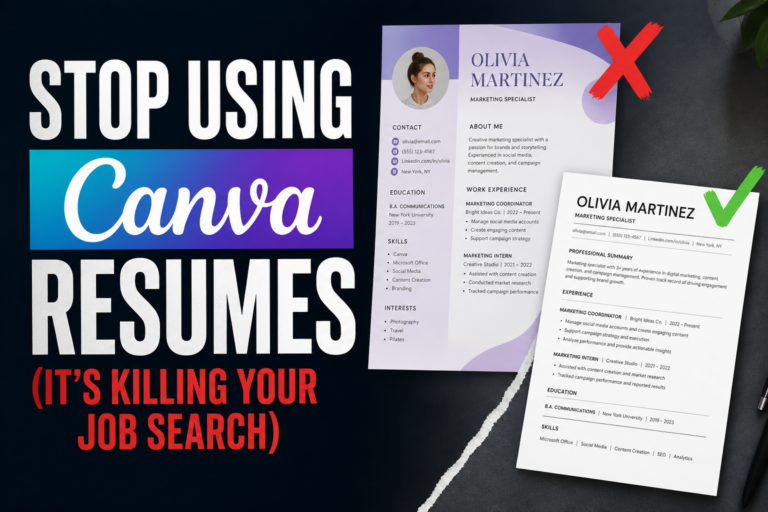
- Clean, simple layout (no tables, columns, or graphics)
- Standard section headers
- Consistent formatting
- Plenty of white space
This is your starting point for every tailored version.
Step 3: Pull Relevant Content for Each Job
For each application:
- Analyze the job description (2 minutes)
- Select relevant experiences from master document (3 minutes)
- Choose matching skills (1 minute)
- Customize summary (2 minutes)
- Adjust keywords throughout (2 minutes)
- Final review (2 minutes)
Total time: 12 minutes to create a fully tailored, ATS-optimized resume.
Step 4: Save Each Version
Name each tailored resume clearly:
- Resume_CompanyName_JobTitle_YourName.pdf
- Resume_Microsoft_SeniorPM_JohnSmith.pdf
This allows you to quickly reference and reuse successful versions for similar roles.
The 2026 Resume Reality: Customize or Lose
Let’s be clear about what’s happening in the job market right now:
The competition has intensified. Global remote work means you’re competing against candidates worldwide. The average job posting receives 250 applications.
The technology has evolved. ATS systems are smarter, more sophisticated, and better at identifying generic applications.
The expectations have changed. Recruiters expect customization. It’s no longer a “nice to have”—it’s the baseline requirement for serious consideration.
Your master CV worked in 2015 because:
- Fewer people used ATS systems
- Competition was less intense
- Recruiters had more time to review each application
- Job descriptions were less specific
None of those conditions exist anymore.
What Happens If You Keep Using a Master CV
Let’s be honest about the consequences:
Short term:
- 4-5x more applications needed per interview
- Longer job search timeline
- More rejection and frustration
- Wasted time on applications that never had a chance
Long term:
- Accepting jobs out of desperation rather than fit
- Lower salary offers (less negotiating leverage)
- Damaged confidence from constant rejection
- Outdated approach that will only get worse
The Alternative:
- Fewer, higher-quality applications
- Better interview conversion rates
- Stronger negotiating position
- Faster path to the right opportunity
The Bottom Line
The master CV is dead. Not because it was a bad idea—it made perfect sense in its time. But 2026 is not that time.
Here’s what the data tells us:
- 63% of recruiters want tailored resumes
- 75% of generic resumes are filtered by ATS
- Tailored resumes get 32% higher response rates
- Customization improves interview rates by 50% or more
Here’s what logic tells us:
- If 250 people apply for every job, you need to stand out
- Standing out requires showing you’re specifically qualified for THIS role
- Generic resumes can’t demonstrate specific qualification
- Therefore, generic resumes can’t win
Here’s what experience tells us:
- Job seekers who customize get hired faster
- Those who don’t customize submit 4-5x more applications for the same results
- The “time saved” by using a master CV is an illusion
- Efficiency isn’t measured by applications sent. It’s measured by offers received
The choice is yours: Keep fighting a losing battle with your master CV, or adapt your strategy to what actually works in 2026.
The market has spoken. Customization isn’t optional anymore.
Cut your customization time from 20 minutes to 5 minutes: ApplyIn5 automatically tailors your resume to each job on any job portal including Naukri, Bayt, and GulfTalent. Giving you the conversion rates of customization without the time investment. In 2026’s competitive job market, you need both quality AND speed. Learn more at ApplyIn5.com.